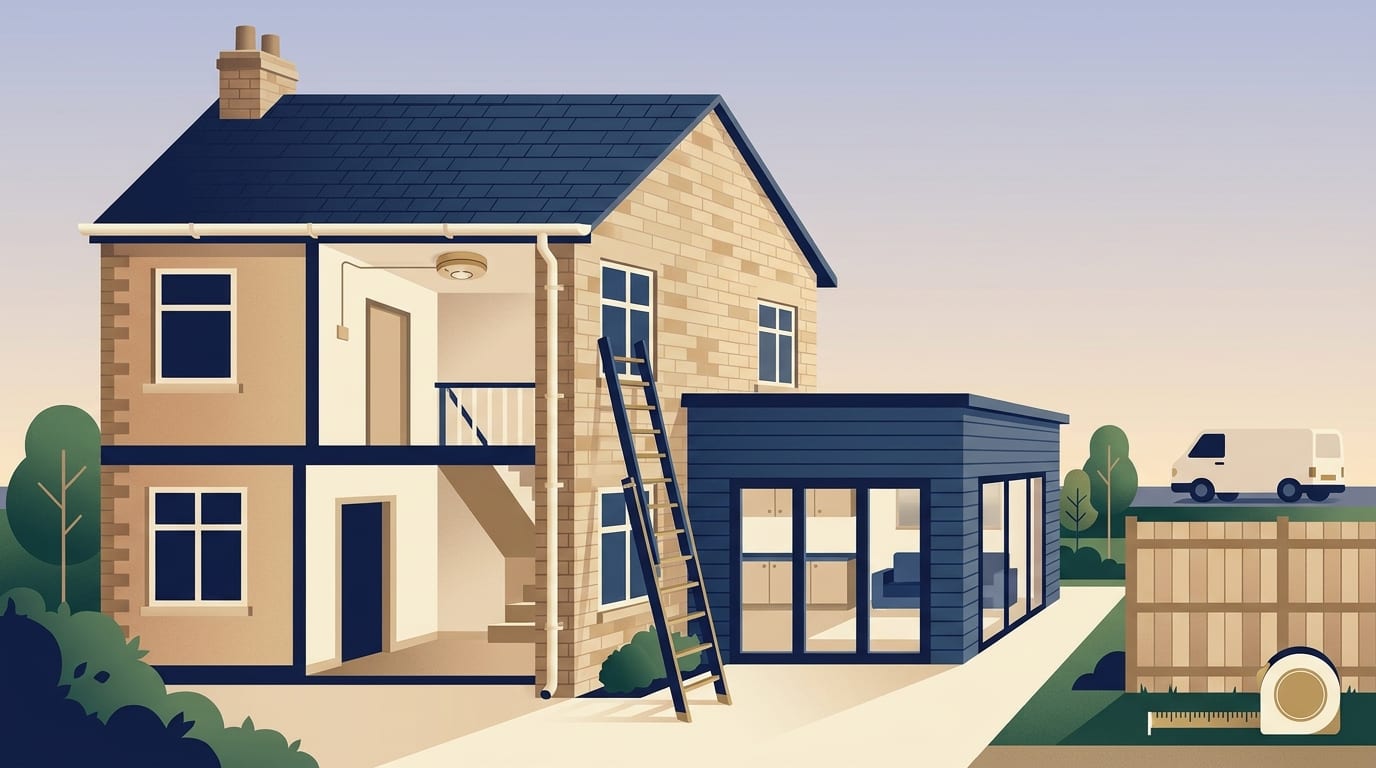

A lawful development certificate is an official council decision confirming that a use, operation or activity is lawful for planning purposes. Applying for one is optional, but it gives you formal written proof that your building project falls under permitted development rules. A certificate may come in useful when selling your property in the future.
What a lawful development certificate is
According to GOV.UK, a lawful development certificate is a document from the local planning authority confirming that a use, operation or activity is lawful for planning purposes. Anyone can apply to the local planning authority to obtain a decision. It confirms that the work does not require planning permission.
Applying is entirely optional. Many homeowners complete extensions or loft conversions under permitted development rights without ever applying for a certificate. Permitted development rights allow certain improvements without a full planning application, provided they stay within set limits on size, height and position. Flats and maisonettes do not have these rights. Conservation areas, listed buildings and properties with planning conditions are also more restricted.
While you can proceed without a certificate, informal council advice is not legally binding. Harborough District Council states that without a certificate, any informal advice you receive is not legally binding. A formal certificate confirms in writing that the work does not require planning permission.
Proposed and existing certificates
There are two kinds of certificate you can apply for. They serve the same purpose but apply to different stages of a building project.
Proposed certificates
A proposed certificate falls under section 192 of the planning rules. It covers a proposed use of buildings or other land, and proposed operations. You apply for this before you start building to confirm your planned work is permitted development.
Once a proposed certificate is granted, the development carried out in accordance with it must be presumed lawful unless there is a material change. If you change the design, talk to the council first, because the certificate may no longer protect you.
Existing certificates
An existing certificate falls under section 191 of the rules. It covers an existing use of land, among other matters, including activity in breach of a planning condition. You apply for this after the work is already done.
An existing certificate relates only to the state of affairs on the land at the date of the application. It confirms whether planning permission was needed for work already done. An existing certificate can be applied for after the project is finished, for example when you plan to sell.
When you should consider getting one
You should think about applying for a proposed certificate before you hire a builder for a major project. If you are planning an extension, you might wonder whether you need planning permission for an extension or loft. If you believe your plans are permitted development, the certificate confirms it in writing before you start.
A certificate may come in useful when selling your property in the future. Buyers and their solicitors may ask for proof that work was lawful. They want to know the council will not take enforcement action against them once they buy the house. A certificate is not strictly required to sell a house.
Getting an existing certificate clears up any doubts about past building work. If you bought a house with an extension and the previous owners left no paperwork, applying for an existing certificate gives you peace of mind and prepares the house for when you eventually sell it.
How building work is scoped and priced
Before you apply for a certificate or hire a firm, you need to understand how building work is scoped and priced. You will usually hire a general builder or main contractor. This is the company that manages the project and brings in subcontractors. Subcontractors are specialist tradespeople like plumbers, roofers and plasterers hired by the main contractor to do specific parts of the job.
Builders price from drawings and a specification, not from a cost per square metre. Per square metre figures are only a way to set an early budget. Figures differ widely because some cover a basic shell and others a finished room. A specification is a detailed document listing exactly what materials and finishes will be used. A schedule of works is a list of tasks in the order they will be done.
You need these drawings to apply for your lawful development certificate, and you need them to get accurate prices from builders. Starting without drawings, a specification or a written contract is a common mistake. Choosing a builder on price alone is another common mistake.
A proper quote is fixed, meaning the price will not change unless the work changes. An estimate is not fixed and is only a rough guess at the final cost. Accepting an estimate as if it were a quote is a common mistake. Your quote should include all the labour and materials required. Labour is a large share of any job.
Prices usually exclude certain costs. Kitchens and bathrooms, flooring and decoration, professional fees, planning and building control fees, party wall costs and VAT at 20 per cent are normally outside a build quote. London and the South East cost more. Your final quote might include provisional sums. These are allowances for things that cannot be priced yet, like a specific type of brick that has not been chosen. You should also hold back a contingency fund. A contingency is a pot of your own money kept in reserve for unexpected problems, like poor ground conditions.
You will pay your builder in stages. Stage payments are partial payments tied to progress on site. A good contract ties these payments to specific milestones. One milestone is making the building weathertight, which means the roof is on, the walls are up and the windows are in, so rain cannot get inside.
Another milestone is the end of the first fix. First fix involves all the hidden structural work, pipes and cables before the walls are plastered. Second fix covers everything that comes after plastering, like connecting sockets, fitting taps and hanging doors.
Never pay large cash deposits. Cash deals offered without VAT or paperwork are a common mistake to avoid. Cowboy builders take on more jobs than they can staff. You are protected by the Consumer Rights Act 2015, which states work must be done with reasonable care and skill, for a reasonable price and within a reasonable time where none was agreed. You also have a 14-day cooling-off period for contracts agreed at home, by phone or online. Credit card payments offer Section 75 protection if things go wrong.
If you change your mind about the design mid-build, this creates variations. Variations are changes after the price is agreed. Changing the design mid-build without agreeing the cost in writing is a fast way to lose control of your budget. It can also mean the work no longer matches a proposed lawful development certificate, so talk to the council before changing the design.
The final payment on completion should only be handed over when everything is finished. This means you hold back a small percentage of the total cost until snagging is done. Snagging is the process of finding and fixing minor defects, like a scratched door or a loose skirting board, at the end of the job. Paying the final instalment before snagging and certificates are done leaves you with no leverage to get mistakes fixed.
What evidence the council needs
To get a lawful development certificate, you must provide enough information for the council to make a decision. The application must include sufficient factual information and evidence for the council to decide it. You must describe precisely what is being applied for. The council will not guess what you mean or fill in the blanks for you.
For a proposed certificate, you need to describe precisely what you plan to do, and clear drawings of the existing house and the proposed changes are the usual way to do that. The council will check the proposal against the permitted development limits.
For an existing certificate, the burden of proof is much higher. Evidence must be sufficiently precise and unambiguous to justify a grant on the balance of probability. You have to prove that the work was done, exactly when it was done, and what the finished structure looks like.
Evidence that may help for an existing certificate includes:
- Dated photographs of the building work taking place.
- Invoices and receipts from the builders who did the job.
- Building control completion certificates showing the date the work was signed off.
- Sworn statutory declarations from people who know when the work was completed.
- Surveys or other records from when the house was previously sold.
What a certificate does and does not do
A lawful development certificate only deals with planning rules. It does not remove the need to meet other requirements such as building regulations or listed building consent. Being told building regulations are not needed is a common scam. Planning permission and building regulations are two separate systems and many projects need one, both or neither.
Building regulations approval is needed for extensions, loft conversions and most structural and services work. This system ensures the building is safe, structurally sound and energy efficient. Approval comes from council building control or a registered building control approver. Certain trades can self-certify their work through a competent person scheme. For example, gas work needs a Gas Safe registered engineer and electrical work needs a registered electrician. Always confirm membership on the scheme's own register and treat it as a good sign, not a guarantee. At the end of the project, you receive a completion certificate for building regulations. This completion certificate matters when selling and is entirely separate from a lawful development certificate.
Many projects also need a structural engineer's calculations. These are detailed mathematical reports proving that steel beams and foundations will support the weight of the building. They are a building regulations matter, so they are separate from the lawful development certificate.
You also have duties regarding health and safety. Under the CDM Regulations 2015 a domestic client's health and safety duties normally pass to the builder. Houses built or refurbished before 2000 may contain asbestos, which must be dealt with by competent people.
Finally, you must follow the Party Wall etc. Act 1996. This applies in England and Wales to work on or near a shared wall or boundary. You must tell your neighbours about building work near or on your shared property boundary, and party wall agreements are separate from planning permission and building regulations approval. Scotland and Northern Ireland have their own systems, so check locally. Do not forget to tell your home insurer about the work, as not telling them is a common mistake.
What a lawful development certificate costs
Applying for a certificate requires an application fee. An application must be accompanied by the relevant application fee. The cost depends on whether you are applying for a proposed or existing certificate.
The figures below show the GOV.UK fees for planning applications in England from 1 April 2026. The baseline cost for a householder planning application to enlarge, improve or alter a single dwellinghouse is 548 pounds. Fee values rise each April.
The following table shows the fees for a lawful development certificate in England from 1 April 2026.
|
Application type |
Fee amount |
|---|---|
|
Proposed use or operation |
Half the full application fee |
|
Existing use or operation |
Same as the full application fee |
|
Existing use or operation lawful not to comply with any condition or limitation |
309 pounds |
Fee values rise each April, so confirm the exact fee with your local council before you apply.
If the application is refused
Sometimes a council will refuse to grant a lawful development certificate. A refusal is not necessarily conclusive that something is unlawful. It may simply mean that insufficient evidence has been presented so far. If you applied for an existing certificate but did not provide enough clear photographs or invoices, the council may refuse it. A later application is possible once you gather better proof.
If your proposed certificate is refused, ask the council why, as a refusal may mean only that insufficient evidence has been presented so far. Planning permission may be needed instead, so confirm with the council. If you have already built an extension and the existing certificate is refused, you might need to apply for retrospective planning permission to regularise the work.
If you are in dispute with a builder over work that does not meet the rules, Citizens Advice is the signpost for disputes. Trade schemes can also help. The Federation of Master Builders vets and independently inspects members. TrustMark is the government-endorsed quality scheme.
Certificate or planning permission
It is easy to confuse a lawful development certificate with planning permission. A certificate confirms that the work is lawful for planning purposes. Once a proposed certificate is granted, work carried out in line with it must be presumed lawful unless there is a material change. A certificate does not remove the need to meet other requirements such as building regulations or listed building consent.
Planning permission is a request for the council to allow work that is not permitted development. In England most applications are decided within 8 weeks, and work must start within three years of permission being granted (five in Wales). You submit your drawings and the council decides whether to allow it based on local policies, design guidelines and objections from neighbours.
A lawful development certificate is a decision on the facts. The application must include sufficient factual information and evidence for the council to decide it.
Common questions
Do I have to get a lawful development certificate?
No. Applying is entirely optional. If your project meets all the permitted development limits, it is lawful whether you have a certificate or not. Having the document provides written proof, which may come in useful when selling the property.
Can I sell my house without a certificate?
Yes, you can sell a house without one. Buyers and their solicitors may ask for proof that work was lawful, but they can still choose to buy the house if you do not have it. A certificate gives written confirmation that the work does not require planning permission.
Does a certificate cover building regulations?
No. A certificate only deals with planning rules. You still need separate building regulations approval for the structural safety, fire safety and energy efficiency of the work. You will get a separate completion certificate from building control when the job is done.
Who can apply for a lawful development certificate?
Anyone can apply to the local planning authority to obtain a decision. You do not need to own the land to apply, though usually it is the homeowner or their architect who submits the paperwork to the council.
Your next steps
If you are ready to move forward with your project or need paperwork for a past build, follow these steps.
- Check the permitted development rules for your property type and location.
- Hire an architectural designer to draw up clear, precise plans of the existing house and the proposed work.
- Submit the drawings and application to your local council along with the correct fee.
- Wait for the council to issue the certificate before you start any work.
- Ensure you also apply for building regulations approval and serve any necessary party wall notices.
- Get three written quotes against the same drawings and specification.
- Visit finished jobs and check the builder's proof of insurance before signing a written contract.
Getting the paperwork right before you start protects your budget and your home's future value. When you have your drawings and your certificate in hand, you can confidently find a builder near you to price the work.
Find a top rated builder near you
3,554 builders across the UK, each ranked on their Google rating and the number of reviews behind it. Start with your county: